




Article précédent
In 2026, Art Deco is undergoing a quiet renaissance.
From the reopening of the Waldorf Astoria in New York to the tribute to Art Deco heritage at the Fairmont Mumbai, and the global pursuit of the "Neo Deco" style by designers worldwide–geometric symmetry, metallic lines, and high‑contrast colour blocks are once again becoming the narrative language of high‑end spaces.
More: yakco technology
But there is one question that designers rarely discuss on renderings, yet encounter repeatedly after project completion:
How long can those delicate gold lines actually "survive" in real spaces?
On the walls of hotel elevator lobbies, the metal corners of suitcases brush past dozens of times a day; on display cabinets in boutique stores, customers' keys and jewellery accidentally scrape across; on wall cladding in high‑end residences, bumps during furniture moving are hard to avoid entirely.
The delicacy of Art Deco is, at its core, the delicacy of lines–once a gold line is broken, the entire visual logic of the pattern is disrupted.
Behind Yakco data lies a more specific question: How does a scratch resistance of 1.5N protect a gold line that is only 0.3mm wide?
1.The "Survival Threshold" of a 0.3mm Gold Line
The gold lines of Art Deco typically range from 0.3mm to 1mm in width. What does 0.3mm mean? It is roughly the thickness of three strands of hair.
A 0.3mm gold line is visually sufficient to form a delicate decorative language; physically, it is fragile enough that a single slightly heavy scratch may "break" it.
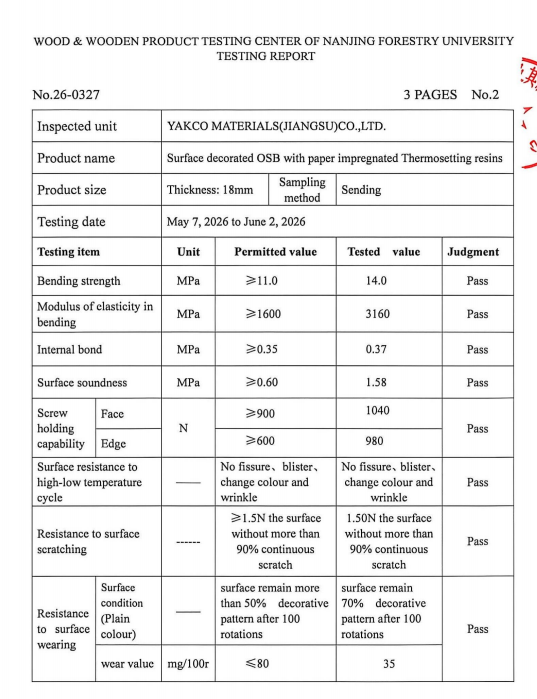
In the scratch resistance test, a load of 1.5N is equivalent to 150 grams of force–roughly the weight of an egg concentrated on a contact point the size of a pinhead.
Under this load, a stylus moves across the board surface at a constant speed to observe whether a continuous scratch exceeding 90% is produced.
YAKCO achieved a Pass at 1.5N. This means that under this load, the stylus does not leave long, deep continuous scratches on the decorative layer.
In other words, a 0.3mm gold line, when scratched with a concentrated force of 150 grams, will not "break"–only extremely slight and discontinuous marks may appear, which are unnoticeable from a distance and do not compromise the integrity of the pattern even upon close inspection.
2.Why Are Art Deco Gold Lines "More Afraid" of Scratches?
Patterns on ordinary decorative panels usually consist of large colour blocks or repeating textures, where local scratches can be easily "absorbed" by the overall visual.
But Art Deco's pattern logic is completely different:
- Lines are the visual skeleton.
The geometric beauty of Art Deco relies on the continuity and precision of its lines– vertical stripes must run straight through, fan‑shaped rays must radiate completely from the centre, and every turn of a stepped border must be clear.
Any interruption in any line disrupts the entire geometric order.
Metallic textures amplify flaws.Gold, silver, copper–the high‑reflectivity of these metallic inks makes any scratch more noticeable than on a matte surface.
A fine white scratch against a gold background has extremely high visual contrast.
Large‑scale applications leave no place for flaws to hide.Art Deco is often used on large wall surfaces and full cabinet doors.
On a 3‑metre‑high wall cladding, any damage to any line is magnified. Local flaws on ordinary patterned panels can be ignored, but flaws in Art Deco lines will "jump out."
YAKCO's scratch resistance of 1.5N precisely responds to Art Deco's extreme demand for line integrity.
The Process Logic Behind 1.5N
Scratch resistance is not simply a matter of "making the surface harder."
It depends on synergy across three levels:
The crosslinking density of melamine resin. The scratch resistance of the decorative layer is essentially determined by the density of the three‑dimensional network structure formed after the resin cures.
The higher the crosslinking density, the harder it is for the stylus to penetrate the resin layer. YAKCO's pressing process achieves optimal resin curing through precise control of hot‑pressing temperature, pressure, and time.
The rigidity of the substrate support.
In the scratch resistance test, when the stylus presses down, it tests not only the decorative layer but also the substrate's supporting capacity.
If the substrate deforms slightly under the stylus pressure, the decorative layer sinks with it, resulting in deeper scratches.
YAKCO's substrate density is stable at 0.72 g/cm³, providing a flat, rigid supporting surface for the decorative layer.
- The uniformity of the decorative layer thickness.
The uniformity of resin impregnation in the impregnated paper determines whether scratch resistance is consistent across all areas of the decorative layer.
Localised insufficient resin content creates "weak spots" in scratch resistance.
YAKCO's impregnation process ensures uniform resin distribution across the entire decorative layer, with no local "soft zones."
4.From the Laboratory to Real Spaces: What 1.5N Actually Means
Translating 1.5N from the laboratory into real‑world usage scenarios:
Elevator lobby walls in hotels–the edges of metal suitcase corners sliding across the wall at a certain speed typically generate contact pressure between 1.0N and 2.0N.
YAKCO's 1.5N scratch resistance means that most everyday scratches will not leave continuous scars on the gold lines.
Display cabinets in boutique stores–customers' bracelets, keys, and phone edges accidentally scrape across cabinet doors.
The contact pressure of these hard objects is typically between 0.5N and 1.5N.
YAKCO's decorative layer can withstand these everyday contacts without being "disfigured."
Wall cladding in high‑end residences–minor bumps during furniture moving, hard edges of children's toys. The pressure of these occasional contacts is typically between 1.0N and 2.5N.
A scratch resistance of 1.5N provides a margin for these "accidents."
5.The "Invisible Support" of the Substrate
The scratch resistance performance ultimately depends on the underlying stability of the substrate.
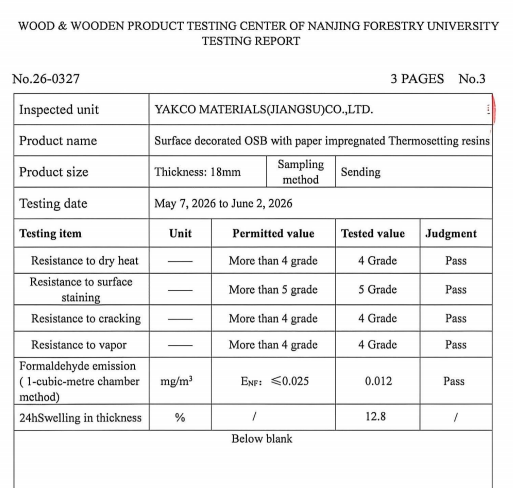
YAKCO's substrate has a stable density of 0.72 g/cm³ and internal bond of 0.37 MPa, ensuring that the decorative layer does not suffer deeper scratches due to substrate deformation under the stylus pressure.
A stable substrate allows the decorative layer to "hold up."
Conclusion: The "Survival Logic" of a Gold Line
The gold lines of Art Deco are the soul of the design language. A 0.3mm gold line carries the entire visual logic of the geometric order.
YAKCO Art Deco Melamine Board answers the most practical question for designers with a scratch resistance of 1.5N: How long can these delicate lines survive in real spaces?
The answer is: at least until the next design trend arrives. And the lines will still be intact.